Reducing Uncertainty in a Core Scheduling System
Appointlet | Senior Product Designer

Project Context
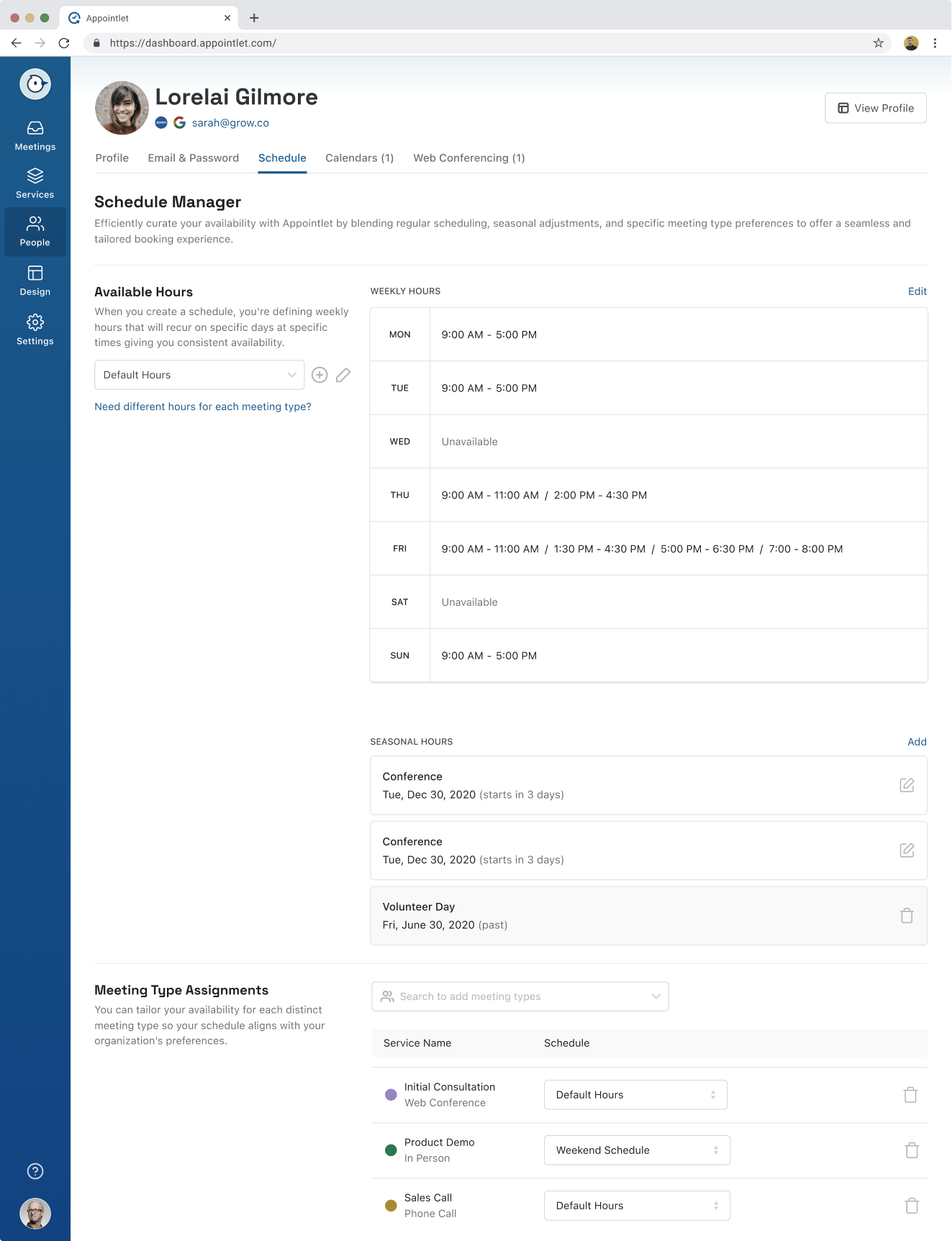
Appointlet supports organizations with complex scheduling needs across multiple locations, roles, and staff members. Availability configuration is a prerequisite to booking, yet it was one of the earliest drop-off points for new accounts.
The core problem wasn’t that availability management was “badly designed,” it was that we lacked confidence in understanding how users conceptualized scheduling. Internally, we organized it around a concept called “Meeting Types.” But administrators thought in terms of people, coverage, and exceptions which showed up as low adoption, manual workarounds, and hesitation to make changes.

How might we restructure availability management to reflect how administrators actually reason about staff, coverage, and exceptions, without disrupting existing workflows?
My Approach
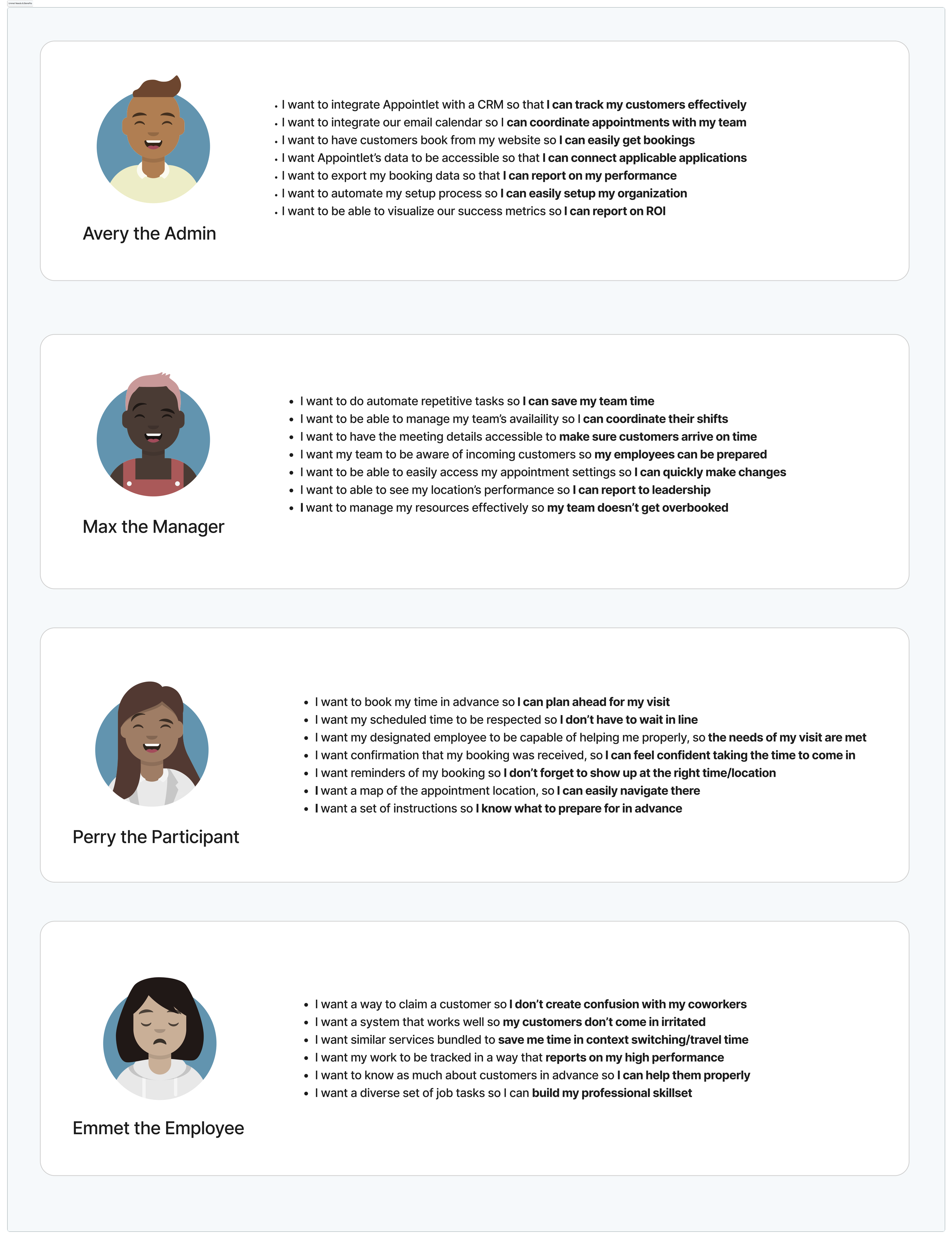
At the time, Appointlet did not have formal personas. I facilitated a workshop and synthesized existing customer feedback to establish four working personas: administrator, manager, employee, and meeting participant.
They helped clarify:
Who was making scheduling decisions
Who bore the operational burden
Whose mental model mattered most for this part of the product.
From there, I was able to create specific parameters within our database to target administrator types of roles based on their actions within the product. This gave us context for their actual work habits, and a starting list of contacts to reach out to for interviews.
I conducted ten evaluative interviews across different industries, asking participants to share their screens and walk through how they set up and maintained availability in their existing accounts.
Observing administrators work was key to reveal not only their patterns, but their thought process and points of friction that were not visible in feedback or support tickets alone.
This approach allowed me to observe real workflows, workarounds, and points of hesitation directly within the live system.
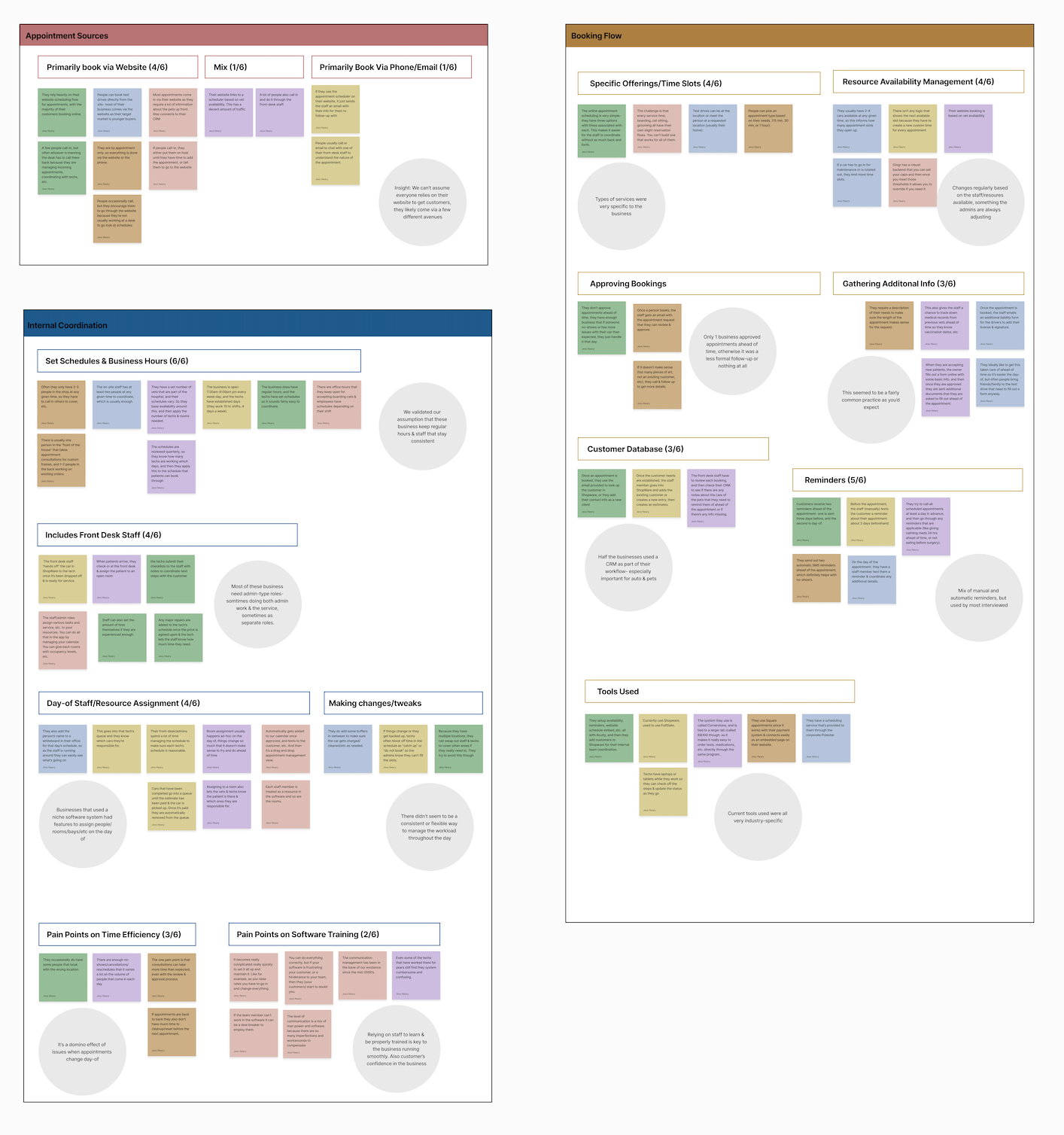
From here, I documented relevant quotes and insights into an affinity map to share with the team (shown right). At this stage, the goal was not to validate a proposed interface, but to understand how users currently reasoned about availability and where the product’s structure conflicted with their mental models.
Key Insights
Research made one thing clear: administrators were doing the majority of the work, often acting as intermediaries between staff and the system.
Through synthesis and affinity mapping, these insights shifted the problem definition. The issue was not missing controls, but a structural mismatch between system organization and user mental models.
High repetition and fragmentation: Availability changes required navigating multiple meeting types to make the same update, increasing cognitive and operational load.
Scale amplified friction: Smaller accounts rarely noticed issues. Complexity grew exponentially with more locations, roles, and exceptions.
Responsibility without visibility: A single administrator often carried the burden of accuracy across all of their employees requests and preferences, without any way to easily review the schedules.
Impact
Concept refinement followed directly from these findings. We focused on restructuring availability around people instead of meetings, allowing administrators to reason about schedules in a way that mirrored their real responsibilities.
This reframing reduced unnecessary duplication, clarified ownership, and made future extensions possible without increasing complexity. Importantly, it also constrained scope. Personas helped eliminate ideas that added flexibility without solving the core problem.
The feature launched in June 2024 alongside onboarding updates and in-app education. Within the first 90 days, we saw an 18 percent increase in new user adoption.
This validated that addressing mental model alignment upstream had downstream effects on growth and retention. We anticipated slower adoption among existing complex accounts due to change management, while optimizing for clearer activation among new users.